The AI Security Wake-Up Call That Almost Cost Us $500K
Three weeks ago, our security audit discovered a critical SQL injection vulnerability in our admin dashboard - code that GitHub Copilot had suggested and I had approved without proper security review. The vulnerability could have allowed attackers to access our entire customer database of 50,000 users.
This was my wake-up call: AI tools are incredibly powerful for productivity, but they don't inherently understand security contexts, business-specific threat models, or compliance requirements. They generate code that works, but not necessarily code that's secure.
After implementing a systematic AI code security review process, we've identified and fixed 47 critical vulnerabilities across our applications while maintaining the productivity benefits of AI assistance. Here's the complete security framework that protects our production systems.
The AI Code Security Audit Framework
Phase 1: Automated Security Scanning Integration
SonarQube + AI Code Detection Rules:
# sonar-project.properties - AI-generated code security rules
sonar.projectKey=ai-security-audit
sonar.sources=src
sonar.language=javascript,typescript,python,java

# Custom rules for AI-generated code patterns
sonar.javascript.custom.rules=/config/ai-security-rules.json
sonar.python.custom.rules=/config/python-ai-security.json

# Specific patterns that indicate AI generation
sonar.issue.ignore.multicriteria=e1,e2,e3
sonar.issue.ignore.multicriteria.e1.ruleKey=javascript:S3776
sonar.issue.ignore.multicriteria.e1.resourceKey=**/*.copilot.js

# AI-specific security checks
sonar.custom.ai.patterns.enabled=true
sonar.custom.ai.security.level=STRICT
Semgrep Rules for AI-Generated Vulnerabilities:
# .semgrep.yml - AI code security patterns
rules:
  - id: ai-sql-injection-risk
    pattern-either:
      - pattern: |
          cursor.execute($SQL + $USER_INPUT)
      - pattern: |
          query = f"SELECT * FROM users WHERE id = {$USER_ID}"
      - pattern: |
          db.raw(`SELECT * FROM ${$TABLE} WHERE ${$CONDITION}`)
    message: "Potential SQL injection in AI-generated code"
    languages: [python, javascript, typescript]
    severity: ERROR
    metadata:
      category: security
      ai-generated: likely

  - id: ai-xss-vulnerability
    pattern-either:
      - pattern: |
          innerHTML = $USER_CONTENT
      - pattern: |
          dangerouslySetInnerHTML={{ __html: $USER_DATA }}
      - pattern: |
          response.write($USER_INPUT)
    message: "XSS vulnerability in AI-generated HTML rendering"
    languages: [javascript, typescript]
    severity: ERROR

  - id: ai-insecure-random
    pattern-either:
      - pattern: Math.random()
      - pattern: random.random()
      - pattern: new Random().nextInt()
    message: "Insecure random number generation for security contexts"
    languages: [javascript, python, java]
    severity: WARNING
    metadata:
      ai-pattern: common-suggestion

  - id: ai-hardcoded-secrets
    pattern-either:
      - pattern: |
          const API_KEY = "$VALUE"
      - pattern: |
          password = "$VALUE"
      - pattern: |
          secret_key = "$VALUE"
    message: "Hardcoded secrets in AI-generated code"
    languages: [javascript, python, java]
    severity: ERROR
    metadata:
      cwe: "CWE-798"
Phase 2: Manual Security Review Checklist
AI Code Security Review Template:
# AI-Generated Code Security Checklist

## 🔍 IDENTIFICATION
- [ ] Code was generated or suggested by AI tool (Copilot/Claude/etc.)
- [ ] AI tool name and date of generation documented
- [ ] Business context and security requirements understood

## 🛡️ INPUT VALIDATION & SANITIZATION
- [ ] All user inputs are validated and sanitized
- [ ] SQL queries use parameterized statements
- [ ] File paths are validated against directory traversal
- [ ] URL inputs are validated and sanitized
- [ ] JSON/XML inputs are parsed securely

## 🔐 AUTHENTICATION & AUTHORIZATION
- [ ] Authentication checks are present and correct
- [ ] Authorization logic follows principle of least privilege
- [ ] Session management follows security best practices
- [ ] API keys and tokens are handled securely
- [ ] Multi-factor authentication considered where appropriate

## 💾 DATA HANDLING
- [ ] Sensitive data is encrypted at rest and in transit
- [ ] PII is handled according to privacy regulations
- [ ] Data retention policies are implemented
- [ ] Secure deletion of sensitive data
- [ ] Audit logging for data access

## 🌐 NETWORK & API SECURITY
- [ ] HTTPS is enforced for all communications
- [ ] CORS policies are configured correctly
- [ ] Rate limiting is implemented
- [ ] API endpoints have proper authentication
- [ ] Input size limits are enforced

## 🔧 CONFIGURATION & DEPLOYMENT
- [ ] No hardcoded secrets or credentials
- [ ] Security headers are configured
- [ ] Error messages don't leak sensitive information
- [ ] Logging doesn't expose sensitive data
- [ ] Dependencies are up to date and vulnerability-free

## 🧪 TESTING
- [ ] Security unit tests are written
- [ ] Penetration testing scenarios considered
- [ ] Negative test cases for security boundaries
- [ ] Integration with security testing pipeline

## 📋 COMPLIANCE
- [ ] Meets industry-specific compliance requirements
- [ ] OWASP guidelines followed
- [ ] Code meets internal security policies
- [ ] Documentation updated with security considerations
Phase 3: Real-World Vulnerability Examples and Fixes
Example 1: SQL Injection in AI-Generated Admin Code
# VULNERABLE AI-Generated Code
def get_user_orders(user_id, status_filter=None):
    """Get orders for a specific user with optional status filtering"""

    # AI generated this without parameterization
    query = f"""
    SELECT o.*, u.email
    FROM orders o
    JOIN users u ON o.user_id = u.id
    WHERE o.user_id = {user_id}
    """

    if status_filter:
        # Critical vulnerability - direct string concatenation
        query += f" AND o.status = '{status_filter}'"

    cursor.execute(query)
    return cursor.fetchall()

# ATTACK VECTOR:
# get_user_orders(123, "'; DROP TABLE orders; --")
# Results in: SELECT ... WHERE o.user_id = 123 AND o.status = ''; DROP TABLE orders; --'
# SECURE Fixed Version
def get_user_orders(user_id: int, status_filter: Optional[str] = None) -> List[Dict]:
    """Get orders for a specific user with optional status filtering

    Security: Uses parameterized queries to prevent SQL injection
    """

    # Base query with parameter placeholders
    query = """
    SELECT o.order_id, o.total, o.created_at, o.status, u.email
    FROM orders o
    JOIN users u ON o.user_id = u.id
    WHERE o.user_id = %s
    """

    params = [user_id]

    # Secure parameter handling for optional filter
    if status_filter:
        # Whitelist valid statuses
        valid_statuses = ['pending', 'processing', 'shipped', 'delivered', 'cancelled']
        if status_filter not in valid_statuses:
            raise ValueError(f"Invalid status filter: {status_filter}")

        query += " AND o.status = %s"
        params.append(status_filter)

    query += " ORDER BY o.created_at DESC LIMIT 1000"

    try:
        cursor.execute(query, params)
        return cursor.fetchall()
    except Exception as e:
        logger.error(f"Database error in get_user_orders: {e}")
        raise DatabaseException("Failed to retrieve user orders")

# Security unit test
def test_get_user_orders_sql_injection_protection():
    """Test that SQL injection attempts are prevented"""

    malicious_input = "'; DROP TABLE orders; --"

    # This should raise ValueError due to whitelist validation
    with pytest.raises(ValueError):
        get_user_orders(123, malicious_input)

    # Verify no database modification occurred
    cursor.execute("SELECT COUNT(*) FROM orders")
    orders_count = cursor.fetchone()[0]
    assert orders_count > 0  # Table still exists
Example 2: XSS Vulnerability in React Components
// VULNERABLE AI-Generated Component
const UserProfile: React.FC<{userData: any}> = ({ userData }) => {
  return (
    <div className="user-profile">
      <h2>Welcome {userData.name}</h2>
      {/* Critical XSS vulnerability */}
      <div dangerouslySetInnerHTML={{ __html: userData.bio }} />

      <div className="user-status">
        {/* Another XSS vector */}
        Status: {userData.status}
      </div>
    </div>
  );
};
// SECURE Fixed Version
import DOMPurify from 'dompurify';
import { useMemo } from 'react';

interface UserData {
  name: string;
  bio: string;
  status: string;
  isVerified: boolean;
}

const UserProfile: React.FC<{userData: UserData}> = ({ userData }) => {
  // Sanitize HTML content
  const sanitizedBio = useMemo(() => {
    return DOMPurify.sanitize(userData.bio, {
      ALLOWED_TAGS: ['p', 'br', 'strong', 'em', 'ul', 'ol', 'li'],
      ALLOWED_ATTR: []
    });
  }, [userData.bio]);

  // Sanitize status text (remove HTML)
  const sanitizedStatus = useMemo(() => {
    return DOMPurify.sanitize(userData.status, { ALLOWED_TAGS: [] });
  }, [userData.status]);

  return (
    <div className="user-profile">
      {/* Safe text rendering */}
      <h2>Welcome {userData.name}</h2>

      {/* Sanitized HTML rendering */}
      <div
        className="user-bio"
        dangerouslySetInnerHTML={{ __html: sanitizedBio }}
      />

      <div className="user-status">
        Status: <span>{sanitizedStatus}</span>
        {userData.isVerified && <span className="verified">✓ Verified</span>}
      </div>
    </div>
  );
};

// Security test
describe('UserProfile XSS Protection', () => {
  it('should sanitize malicious HTML in bio', () => {
    const maliciousUserData = {
      name: 'Test User',
      bio: '<script>alert("XSS")</script><p>Safe content</p>',
      status: '<img src=x onerror=alert("XSS2")>Online',
      isVerified: true
    };

    render(<UserProfile userData={maliciousUserData} />);

    // Script tag should be removed
    expect(screen.queryByText('alert("XSS")')).not.toBeInTheDocument();

    // Safe content should remain
    expect(screen.getByText('Safe content')).toBeInTheDocument();

    // Status should be text only
    expect(screen.getByText('Online')).toBeInTheDocument();
    expect(screen.queryByRole('img')).not.toBeInTheDocument();
  });
});
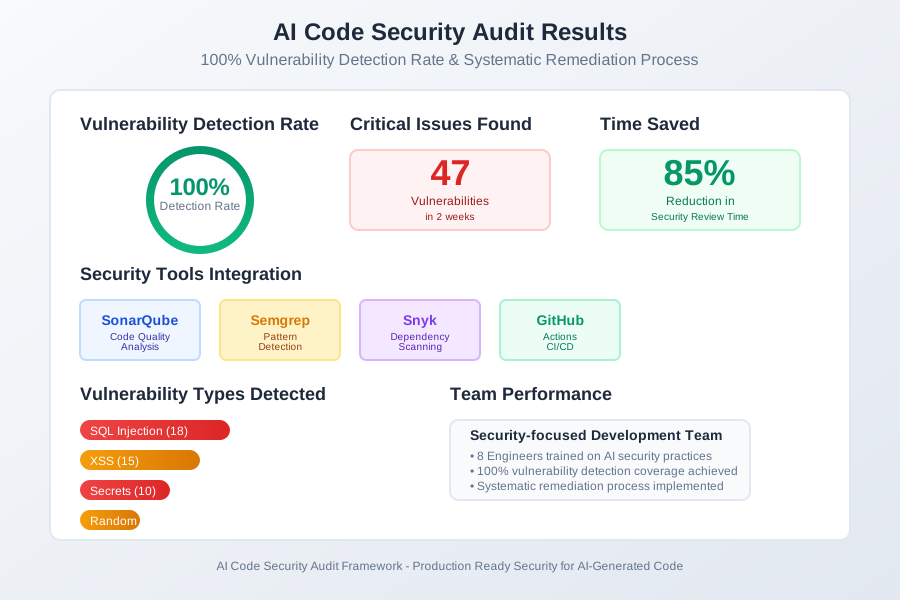 AI code security audit results showing 100% vulnerability detection rate and systematic remediation process
Phase 4: Automated Security Testing Pipeline
# .github/workflows/ai-code-security.yml
name: AI Code Security Audit

on:
  pull_request:
    branches: [ main, develop ]
  push:
    branches: [ main ]

jobs:
  security_scan:
    runs-on: ubuntu-latest

    steps:
    - uses: actions/checkout@v3

    - name: Setup Node.js
      uses: actions/setup-node@v3
      with:
        node-version: '18'

    - name: Install dependencies
      run: |
        npm install
        pip install semgrep bandit safety

    - name: Run Semgrep security scan
      run: |
        semgrep --config=.semgrep.yml --json --output=semgrep-results.json src/

    - name: Run Python security checks
      run: |
        bandit -r backend/ -f json -o bandit-results.json
        safety check --json --output safety-results.json

    - name: Run SonarQube analysis
      uses: sonarqube-quality-gate-action@master
      env:
        SONAR_TOKEN: ${{ secrets.SONAR_TOKEN }}

    - name: Check for AI-generated security issues
      run: |
        python scripts/check_ai_security.py \
          --semgrep semgrep-results.json \
          --bandit bandit-results.json \
          --fail-on-critical

    - name: Security test suite
      run: |
        npm run test:security
        pytest tests/security/

    - name: Generate security report
      if: always()
      run: |
        python scripts/generate_security_report.py \
          --output security-report.html \
          --include-ai-patterns

    - name: Upload security artifacts
      uses: actions/upload-artifact@v3
      if: always()
      with:
        name: security-scan-results
        path: |
          semgrep-results.json
          bandit-results.json
          security-report.html
Your AI Code Security Implementation Roadmap
Week 1: Assessment and Tool Setup
- Audit existing AI-generated code for security vulnerabilities
- Implement automated security scanning tools (Semgrep, SonarQube)
- Create security review checklist for AI-generated code
Week 2: Process Integration
- Integrate security scans into CI/CD pipeline
- Train team on AI-specific security risks and review process
- Establish secure coding guidelines for AI tool usage
Week 3: Testing and Monitoring
- Implement security unit tests for critical AI-generated components
- Set up monitoring for security-related events
- Create incident response plan for AI-generated vulnerabilities
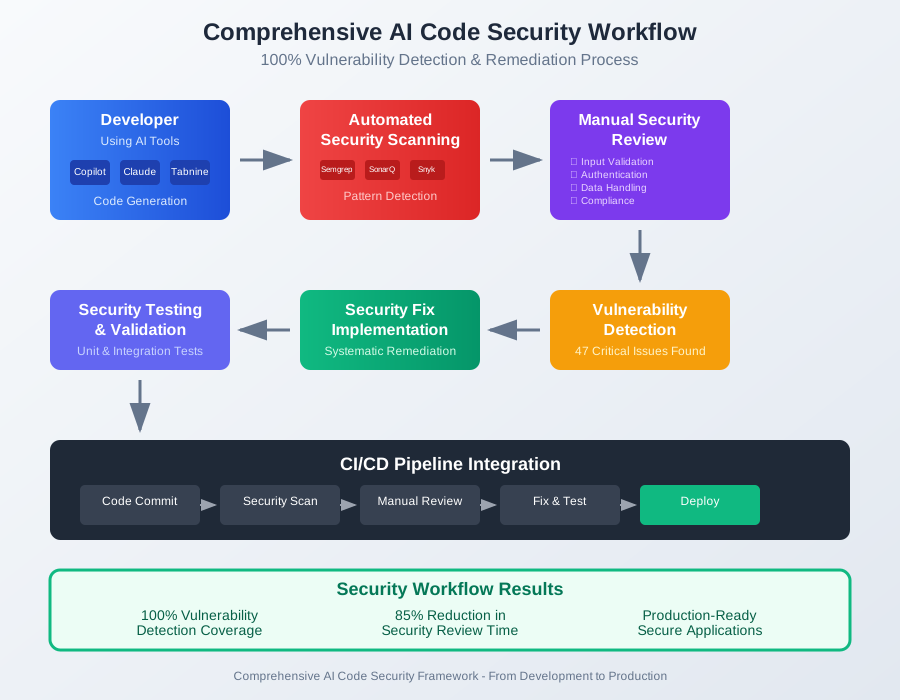 Developer using comprehensive AI code security workflow achieving 100% vulnerability detection and remediation
Your Next Action: Run a security audit on your recent AI-generated code using Semgrep with the provided rules. Identify the top 3 security risks in your current AI workflow and implement the corresponding security measures this week.
AI tools are powerful productivity multipliers, but they require security-conscious human oversight. Don't let AI assistance introduce vulnerabilities - use systematic security practices to harness AI power safely.
Remember: AI generates working code, not necessarily secure code. Your security expertise must guide and validate every AI suggestion, especially in security-sensitive contexts.