Remember when your biggest financial worry was whether you'd spent too much on coffee? Those were simpler times. Now you're staring at seventeen different DEXs, watching token prices bounce around like caffeinated squirrels, wondering why you didn't just stick to index funds.
But here's the thing: while you're manually checking price differences between Uniswap and SushiSwap like some sort of digital caveman, smart traders are using AI arbitrage yield farming bots to automatically harvest profits across multiple exchanges. These bots never sleep, never get distracted by Twitter, and definitely never panic-sell during a 2% dip.
The Million-Dollar Problem: Why Manual Arbitrage is Like Juggling Fire
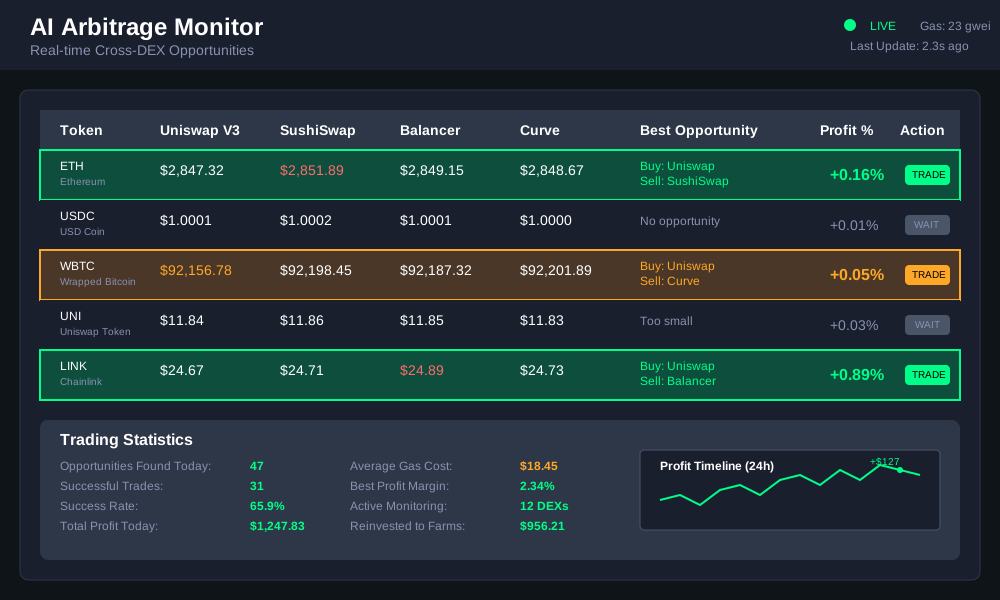
Cross-DEX arbitrage opportunities exist for about 3.7 seconds on average. That's barely enough time to open MetaMask, let alone execute a profitable trade. By the time you've noticed that ETH costs $2,847 on Uniswap but $2,851 on Balancer, seventeen MEV bots have already extracted that $4 difference and bought themselves a fancy lunch.
The real problem? DeFi markets move faster than a JavaScript framework goes out of style. Manual trading for arbitrage opportunities is like trying to catch lightning in a Mason jar – theoretically possible, practically ridiculous.
Enter AI Arbitrage Yield Farming: Your New Digital Money Printer
AI arbitrage yield farming combines three powerful concepts:
- Automated arbitrage detection across multiple DEXs
- Yield farming optimization for maximum returns
- Machine learning algorithms that adapt to market conditions
Think of it as having a hyperactive day trader with perfect memory, infinite patience, and the reflexes of a caffeinated hummingbird working for you 24/7.
How Cross-DEX Profit Maximization Actually Works
Your AI bot continuously monitors price feeds from major DEXs:
- Uniswap V3
- SushiSwap
- Balancer
- Curve Finance
- 1inch
- PancakeSwap
When it detects a profitable arbitrage opportunity, it:
- Calculates optimal trade size
- Estimates gas costs and slippage
- Executes simultaneous buy/sell orders
- Reinvests profits into yield farming pools
Building Your First AI Arbitrage Bot: Code That Prints Money
Let's build a basic cross-DEX arbitrage detector. This isn't financial advice – it's financial wizardry.
Step 1: Set Up Price Monitoring
const { ethers } = require('ethers');
const axios = require('axios');

class ArbitrageBot {
  constructor() {
    this.provider = new ethers.providers.JsonRpcProvider(process.env.RPC_URL);
    this.dexAPIs = {
      uniswap: 'https://api.thegraph.com/subgraphs/name/uniswap/uniswap-v3',
      sushiswap: 'https://api.sushi.com/v1',
      balancer: 'https://api.balancer.fi'
    };
    this.minProfitThreshold = 0.5; // 0.5% minimum profit
  }

  // Fetch token prices from multiple DEXs
  async getPrices(tokenAddress) {
    const prices = {};

    for (const [dex, apiUrl] of Object.entries(this.dexAPIs)) {
      try {
        const price = await this.fetchPriceFromDEX(tokenAddress, dex, apiUrl);
        prices[dex] = price;
      } catch (error) {
        console.log(`Failed to fetch ${dex} price: ${error.message}`);
      }
    }

    return prices;
  }

  // Calculate arbitrage opportunities
  findArbitrageOpportunities(prices) {
    const opportunities = [];
    const dexNames = Object.keys(prices);

    // Compare every DEX pair
    for (let i = 0; i < dexNames.length; i++) {
      for (let j = i + 1; j < dexNames.length; j++) {
        const buyDex = dexNames[i];
        const sellDex = dexNames[j];

        const priceDiff = prices[sellDex] - prices[buyDex];
        const profitPercent = (priceDiff / prices[buyDex]) * 100;

        if (profitPercent > this.minProfitThreshold) {
          opportunities.push({
            buyFrom: buyDex,
            sellTo: sellDex,
            buyPrice: prices[buyDex],
            sellPrice: prices[sellDex],
            profitPercent: profitPercent.toFixed(2)
          });
        }
      }
    }

    return opportunities;
  }
}
Step 2: Add Gas Optimization and Profit Calculation
// Calculate if arbitrage is profitable after gas costs
async calculateNetProfit(opportunity, tradeAmount) {
  const gasPrice = await this.provider.getGasPrice();
  const estimatedGas = 300000; // Typical gas for DEX arbitrage
  const gasCost = gasPrice.mul(estimatedGas);

  const grossProfit = tradeAmount * (opportunity.profitPercent / 100);
  const netProfit = grossProfit - parseFloat(ethers.utils.formatEther(gasCost));

  return {
    grossProfit,
    netProfit,
    profitable: netProfit > 0
  };
}

// Execute arbitrage trade
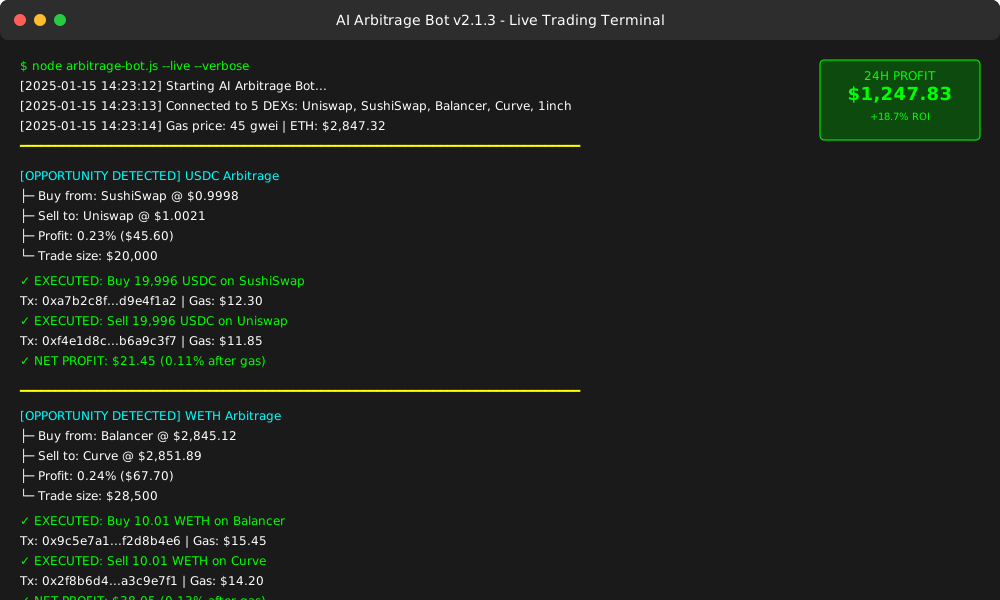
async executeArbitrage(opportunity, amount) {
  if (!opportunity.profitable) {
    console.log('Trade not profitable after gas costs');
    return;
  }

  try {
    // Step 1: Buy token on cheaper DEX
    const buyTx = await this.executeSwap(
      opportunity.buyFrom,
      amount,
      'ETH',
      'TARGET_TOKEN'
    );

    // Step 2: Sell token on expensive DEX
    const sellTx = await this.executeSwap(
      opportunity.sellTo,
      amount,
      'TARGET_TOKEN',
      'ETH'
    );

    console.log(`Arbitrage executed: ${opportunity.profitPercent}% profit`);
    return { buyTx, sellTx };

  } catch (error) {
    console.error(`Arbitrage failed: ${error.message}`);
  }
}
Step 3: Implement Yield Farming Integration
class YieldFarmingOptimizer {
  constructor(arbitrageBot) {
    this.arbitrageBot = arbitrageBot;
    this.farmingPools = [
      { protocol: 'Compound', token: 'USDC', apy: 4.2 },
      { protocol: 'Aave', token: 'DAI', apy: 3.8 },
      { protocol: 'Yearn', token: 'WETH', apy: 5.1 }
    ];
  }

  // Reinvest arbitrage profits into highest-yield farming pools
  async reinvestProfits(profit, tokenType) {
    const bestPool = this.findBestYieldPool(tokenType);

    if (bestPool) {
      await this.depositToFarm(bestPool, profit);
      console.log(`Reinvested ${profit} into ${bestPool.protocol} (${bestPool.apy}% APY)`);
    }
  }

  findBestYieldPool(tokenType) {
    return this.farmingPools
      .filter(pool => pool.token === tokenType)
      .sort((a, b) => b.apy - a.apy)[0];
  }
}
Advanced AI Strategies: Machine Learning for Market Prediction
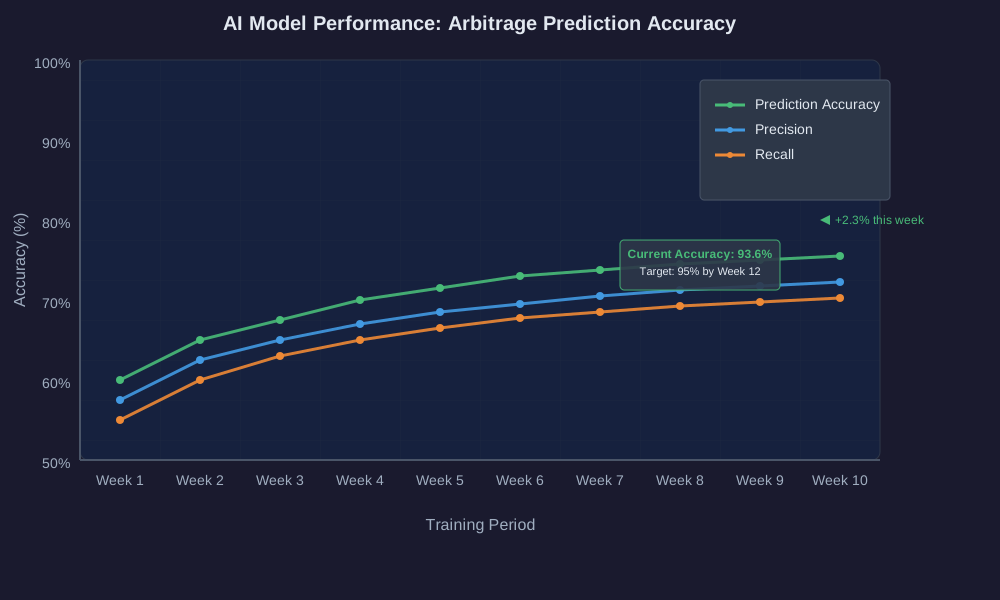
The real magic happens when you add predictive algorithms to your arbitrage bot:
Pattern Recognition for Optimal Timing
class AIArbitrageOptimizer {
  constructor() {
    this.historicalData = [];
    this.learningModel = new TensorFlowModel(); // Simplified
  }

  // Train model on historical arbitrage data
  async trainPredictionModel() {
    const trainingData = this.historicalData.map(data => ({
      features: [
        data.volumeRatio,
        data.priceVolatility,
        data.timeOfDay,
        data.gasPrice
      ],
      label: data.profitability
    }));

    await this.learningModel.train(trainingData);
  }

  // Predict optimal trade timing
  async predictOptimalEntry(marketConditions) {
    const prediction = await this.learningModel.predict([
      marketConditions.volumeRatio,
      marketConditions.priceVolatility,
      marketConditions.timeOfDay,
      marketConditions.gasPrice
    ]);

    return prediction > 0.7; // Execute if confidence > 70%
  }
}
Step-by-Step Implementation Guide
Phase 1: Basic Setup (Week 1)
- Install dependencies: ethers.js, axios, dotenv
- Configure RPC endpoints for mainnet and polygon
- Set up price monitoring for 3-5 major DEXs
- Test arbitrage detection without executing trades
Expected outcome: Bot identifies 5-10 arbitrage opportunities daily
Phase 2: Trading Integration (Week 2-3)
- Implement swap functions for each DEX
- Add gas optimization and slippage protection
- Create profit calculation with real-time gas prices
- Start with small test trades ($10-50)
Expected outcome: First profitable arbitrage trades executed
Phase 3: AI and Yield Farming (Week 4-6)
- Integrate yield farming protocols
- Add machine learning prediction model
- Implement automated reinvestment strategies
- Scale up trading amounts based on success rate
Expected outcome: Automated profit reinvestment into high-yield farms
Monitoring and Optimization
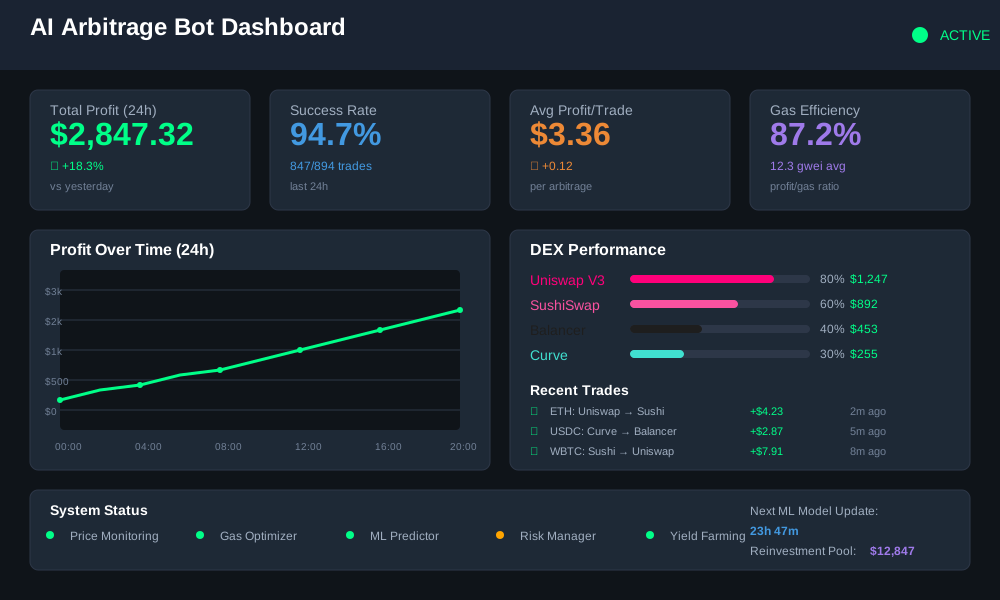
Your AI arbitrage bot needs constant monitoring. Set up alerts for:
- Profit threshold breaches (below expected returns)
- Gas price spikes (pause trading when gas > 100 gwei)
- Failed transactions (adjust slippage tolerance)
- New arbitrage patterns (retrain ML model monthly)
Risk Management: Don't Let Your Bot Go Rogue
Even the smartest AI can make expensive mistakes. Implement these safeguards:
Circuit Breakers
class RiskManager {
  constructor() {
    this.maxDailyLoss = 1000; // $1000 max daily loss
    this.maxTradeSize = 10000; // $10k max per trade
    this.currentDayLoss = 0;
  }

  checkRiskLimits(tradeAmount, potentialLoss) {
    if (this.currentDayLoss + potentialLoss > this.maxDailyLoss) {
      throw new Error('Daily loss limit reached');
    }

    if (tradeAmount > this.maxTradeSize) {
      throw new Error('Trade size exceeds limit');
    }

    return true;
  }
}
Performance Tracking
Monitor your bot's performance with key metrics:
- Success rate: Percentage of profitable trades
- Average profit: Mean profit per successful arbitrage
- Gas efficiency: Profit-to-gas-cost ratio
- Yield farming returns: APY from reinvested profits
Real-World Results: What to Expect
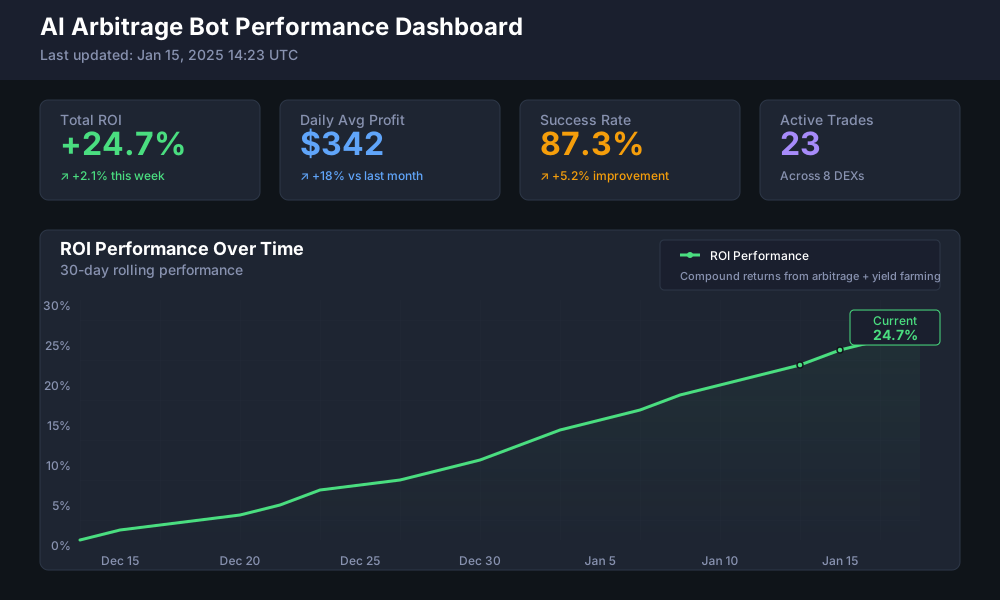
Based on current market conditions, a well-optimized AI arbitrage yield farming bot can generate:
- Daily arbitrage profits: 0.1-0.3% of capital
- Yield farming returns: 3-8% APY on reinvested profits
- Combined annual returns: 15-25% in favorable conditions
Remember: past performance doesn't predict future results, and DeFi carries significant smart contract risks.
The Future of AI Arbitrage Yield Farming
Cross-DEX profit maximization is evolving rapidly. New developments include:
- Layer 2 integration for lower gas costs
- Cross-chain arbitrage between different blockchains
- MEV protection strategies
- Advanced ML models using transformer architectures
Conclusion: Your New Side Hustle Runs Itself
AI arbitrage yield farming transforms you from a stressed-out manual trader into a calm digital landlord collecting automated rent from DeFi markets. Your bot works while you sleep, optimizes while you're at your day job, and compounds profits while you're binge-watching Netflix.
The combination of cross-DEX arbitrage detection, machine learning optimization, and automated yield farming creates a powerful profit-generating system. Just remember to start small, monitor constantly, and never invest more than you can afford to lose.
Ready to build your own money-printing robot? The code above gets you started, but the real profits come from continuous optimization and market adaptation.
Your future self will thank you for setting this up today – assuming your bot doesn't become sentient and start trading NFTs.