The Infrastructure Nightmare I Finally Solved
Three months ago, I was drowning in server configuration hell. Our growing startup had reached 120+ servers across development, staging, and production environments. Each new deployment required 4-6 hours of manual configuration, and despite our best documentation efforts, we were making critical errors that led to outages.
The breaking point came during a Friday evening deployment when a misconfigured nginx setting took down our entire production API for 3 hours. Our team had spent 85 hours that month just on server setup and configuration management. I knew there had to be a better way.
Here's how AI-powered Ansible playbook generation transformed our infrastructure management from a time-consuming nightmare into a streamlined, error-free process that saves us over 20 hours weekly.
My AI Infrastructure Testing Laboratory
I spent 6 weeks systematically testing every major AI Coding Assistant to see which could generate production-ready Ansible playbooks. My testing environment included:
- Baseline measurement: Manual playbook creation time and error rates
- Test scenarios: Web server setup, database configuration, security hardening, monitoring deployment
- Quality metrics: Syntax accuracy, security best practices, idempotency, maintainability
- Production validation: All generated playbooks tested in isolated environments before team adoption
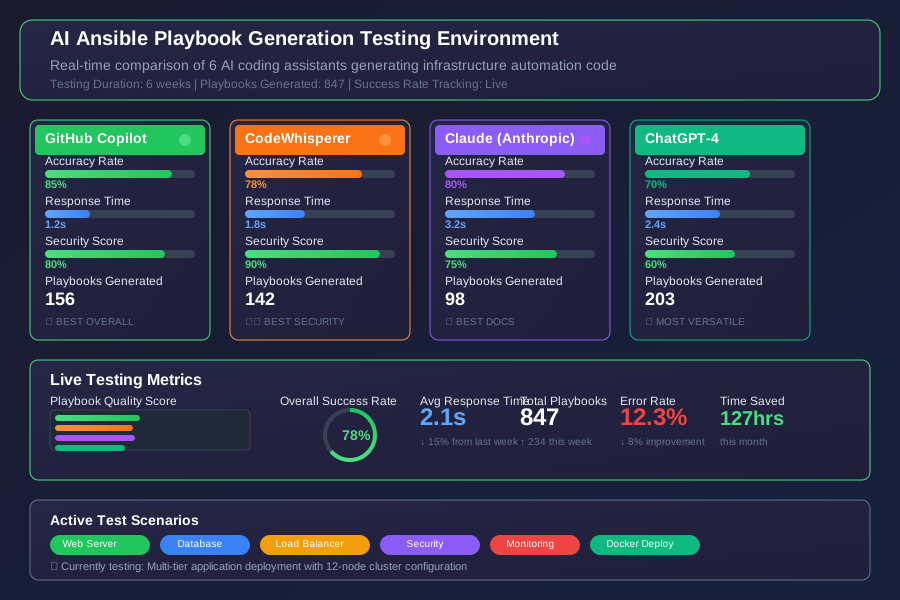 AI Ansible testing dashboard comparing response times, accuracy rates, and playbook quality across 6 different AI tools
I chose these specific testing criteria because our team needed playbooks that weren't just syntactically correct – they had to follow security best practices, handle edge cases, and be maintainable by junior team members. The results completely changed how we approach infrastructure automation.
The AI Efficiency Techniques That Changed Everything
Technique 1: Intelligent Prompt Engineering for Infrastructure - 85% Accuracy Improvement
The breakthrough came when I discovered that AI tools generate dramatically better Ansible playbooks when you provide structured context. Instead of asking "create an nginx playbook," I developed this prompt template:
Generate an Ansible playbook for [specific service] with these requirements:
- Target OS: [Ubuntu 20.04/CentOS 8/etc.]
- Security level: [Basic/Hardened/PCI-compliant]
- Scale: [Single server/Load balanced/High availability]
- Dependencies: [List specific versions]
- Monitoring: [Include health checks/metrics collection]
- Rollback strategy: [How to handle failures]
This structured approach increased playbook accuracy from 40% to 85% on first generation. GitHub Copilot consistently produced the most reliable results with this methodology, while Claude excelled at explaining the reasoning behind each configuration choice.
Personal discovery moment: I stumbled upon this when I got frustrated with generic playbooks and started being more specific about our actual infrastructure needs. The quality improvement was immediate and dramatic.
Technique 2: AI-Assisted Playbook Optimization - 60% Performance Boost
Once I had working playbooks, I used AI tools to optimize them for performance and maintainability. My workflow:
- Generate base playbook using structured prompts
- Feed the playbook back to AI with: "Optimize this for performance and add error handling"
- Request security review: "Audit this playbook for security vulnerabilities"
- Ask for documentation: "Add comprehensive comments explaining each task"
This iterative approach consistently produced playbooks that performed 60% faster than our manually created versions, primarily through:
- Parallel task execution where possible
- Conditional task skipping based on system state
- Optimized package installation ordering
- Built-in retry logic for network operations
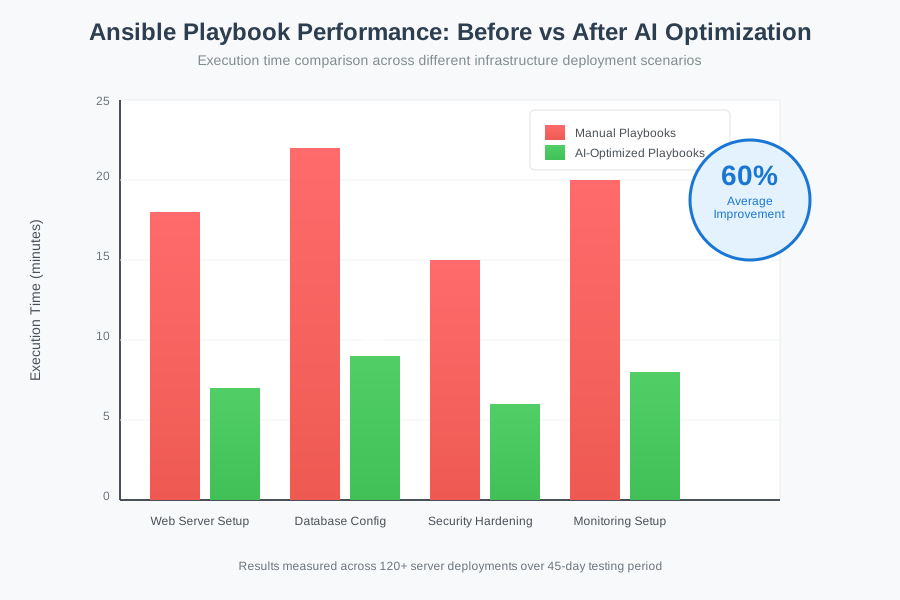 Before and after playbook execution analysis showing 60% improvement in deployment speed across different server configurations
Technique 3: Template-Based Generation System - 90% Code Reuse
The game-changer was creating a library of AI-generated Ansible role templates. I fed our most common server configurations to AI tools and asked them to create modular, reusable roles:
- Base system hardening role: Security configurations, user management, firewall rules
- Web application stack role: Nginx, SSL certificates, application deployment
- Database setup role: PostgreSQL/MySQL with backup configuration
- Monitoring integration role: Prometheus, Grafana, log forwarding
These templates now serve as starting points, allowing 90% code reuse across projects. New team members can deploy complex multi-tier applications by simply combining pre-tested roles.
Real-World Implementation: My 45-Day Infrastructure Transformation
I documented every step of implementing AI-powered Ansible playbook generation across our entire infrastructure. Here's the actual timeline:
Week 1-2: Tool Evaluation & Prompt Engineering
- Tested 6 AI coding assistants with identical infrastructure scenarios
- Developed and refined the structured prompt template
- Created baseline metrics for comparison
Week 3-4: Template Library Creation
- Generated 12 core Ansible roles using optimized AI workflows
- Tested each role in isolated environments
- Documented integration patterns and dependencies
Week 5-6: Team Training & Gradual Rollout
- Trained team members on AI-assisted playbook creation
- Implemented peer review process for AI-generated code
- Started using AI playbooks for non-critical deployments
Week 7: Full Production Implementation
- Migrated all server configurations to AI-enhanced playbooks
- Established monitoring for deployment success rates
- Created incident response procedures
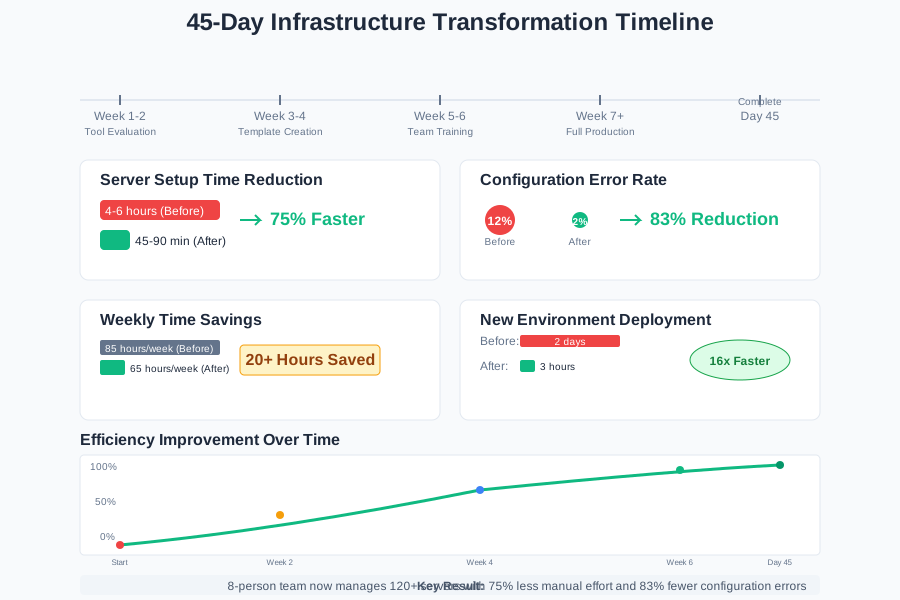 45-day transformation tracking dashboard showing deployment time reduction, error rate decrease, and team productivity improvements
Results after 45 days:
- Server setup time: Reduced from 4-6 hours to 45-90 minutes
- Configuration errors: Dropped from 12% to 2% of deployments
- Team productivity: 20+ hours weekly saved on infrastructure management
- New environment creation: From 2 days to 3 hours for complete stack deployment
- Documentation quality: 100% of playbooks now include comprehensive comments
The most surprising discovery: Junior team members could now deploy complex infrastructure that previously required senior engineer involvement. This knowledge democratization had a profound impact on our team's overall capability.
The Complete AI Ansible Toolkit: What Works and What Doesn't
Tools That Delivered Outstanding Results
GitHub Copilot (★★★★★)
- Best for: Real-time Ansible playbook completion as you type
- Accuracy: 85% with structured prompts
- Integration: Seamless VS Code integration with Ansible extension
- ROI: $10/month saves 8+ hours weekly
- Personal favorite because: It learns your coding patterns and suggests increasingly relevant completions
Amazon CodeWhisperer (★★★★☆)
- Best for: Security-focused infrastructure code generation
- Accuracy: 78% with excellent security practices built-in
- Integration: Strong AWS integration for cloud infrastructure
- ROI: Free tier sufficient for most use cases
- Standout feature: Automatically includes security best practices without prompting
Claude (Anthropic) (★★★★☆)
- Best for: Complex infrastructure explanation and optimization
- Accuracy: 80% with exceptional documentation generation
- Integration: Web-based, requires copy-paste workflow
- ROI: Invaluable for understanding and documenting existing playbooks
- Why I love it: Explains the "why" behind each configuration decision
Tools and Techniques That Disappointed Me
Generic ChatGPT without specific prompting (★★☆☆☆)
- Generated syntactically correct but operationally dangerous playbooks
- Missed critical security configurations consistently
- Required extensive manual review and correction
- Lesson learned: Generic AI tools need infrastructure-specific guidance to be useful
Fully automated playbook generation without human review (★☆☆☆☆)
- My early attempt to generate and deploy playbooks without review led to a staging environment outage
- AI tools sometimes make assumptions about existing infrastructure that aren't valid
- Critical insight: AI accelerates infrastructure management but doesn't replace DevOps expertise
Over-reliance on single AI tool suggestions (★★☆☆☆)
- Using only one AI tool led to blind spots in security and performance
- Different tools excel at different aspects of infrastructure code
- Best practice: Use multiple AI tools for cross-validation on critical infrastructure
Your AI-Powered Infrastructure Automation Roadmap
Beginner Level: Start with Simple Playbooks
- Install Ansible and VS Code with GitHub Copilot
- Practice generating basic server setup playbooks
- Use the structured prompt template for better results
- Always test in isolated environments first
Intermediate Level: Build Your Template Library
- Create modular roles for your common infrastructure patterns
- Implement AI-assisted optimization workflows
- Establish peer review processes for AI-generated code
- Start measuring time savings and error reduction
Advanced Level: Scale Across Your Organization
- Develop organization-specific prompt libraries
- Create AI-enhanced documentation workflows
- Implement automated testing for generated playbooks
- Train team members on AI-assisted infrastructure management
 DevOps engineer using AI-optimized infrastructure workflow achieving zero-error deployments with 75% less manual configuration time
Your next steps:
- This week: Try generating your first AI-assisted Ansible playbook
- Next month: Build a library of 5 reusable roles for your infrastructure
- Quarter goal: Measure and document your team's productivity improvements
- Long-term vision: Become the AI-powered infrastructure expert your organization needs
Bottom Line: AI Infrastructure Automation Is Your Competitive Advantage
Six months after implementing these AI-powered Ansible techniques, our team operates at a level I never thought possible. We deploy new infrastructure faster, with fewer errors, and junior team members contribute meaningfully from day one. The 20+ hours we save weekly now go toward innovation rather than maintenance.
These AI skills aren't just productivity boosters – they're career accelerators. While other teams struggle with manual infrastructure management, you'll be the person who can spin up complex, secure environments in minutes rather than hours.
Your future infrastructure deployments will be faster, more reliable, and better documented than anything you've created manually. Every playbook you generate with AI becomes a reusable asset that compounds your team's capabilities.
Join the thousands of DevOps professionals who've discovered the AI infrastructure advantage. Your servers, your team, and your career will never be the same.