The $50,000 Wake-Up Call That Changed Everything
I'll never forget May 12th, 2023. I was drinking my morning coffee when my phone started buzzing with notifications. My algorithmic stablecoin investment had just depegged from $1.00 to $0.23 in under six hours. Fifty thousand dollars—gone.
That crushing moment taught me something crucial: traditional algorithmic stablecoins fail because they can't adapt to black swan events. They follow rigid rules while markets behave irrationally. I spent the next 18 months building something different—a stablecoin governed by Artificial General Intelligence that can actually think, learn, and adapt in real-time.
Here's how I built the first truly autonomous stablecoin, the mistakes that nearly killed the project, and why AGI might be the future of decentralized finance.
Why Traditional Stablecoin Algorithms Keep Failing
The Problem I Lived Through
After losing my investment, I dove deep into algorithmic stablecoin mechanics. Every major failure—from Terra Luna to Iron Finance—followed the same pattern. These systems used simple if-then logic:
// This is basically how most algorithmic stablecoins work
if (price > 1.01) {
    increaseSupply();
} else if (price < 0.99) {
    decreaseSupply();
}
I realized these algorithms are like playing chess with only three moves while your opponent uses the entire playbook. Markets are complex adaptive systems, but we were trying to control them with basic math.
The Emotional Roller Coaster of Research
For three months, I studied every failed stablecoin mechanism. Late nights turned into early mornings as I traced through transaction logs, analyzed price feeds, and mapped failure cascades. The frustration was overwhelming—every algorithm had the same fundamental flaw.
They couldn't learn.
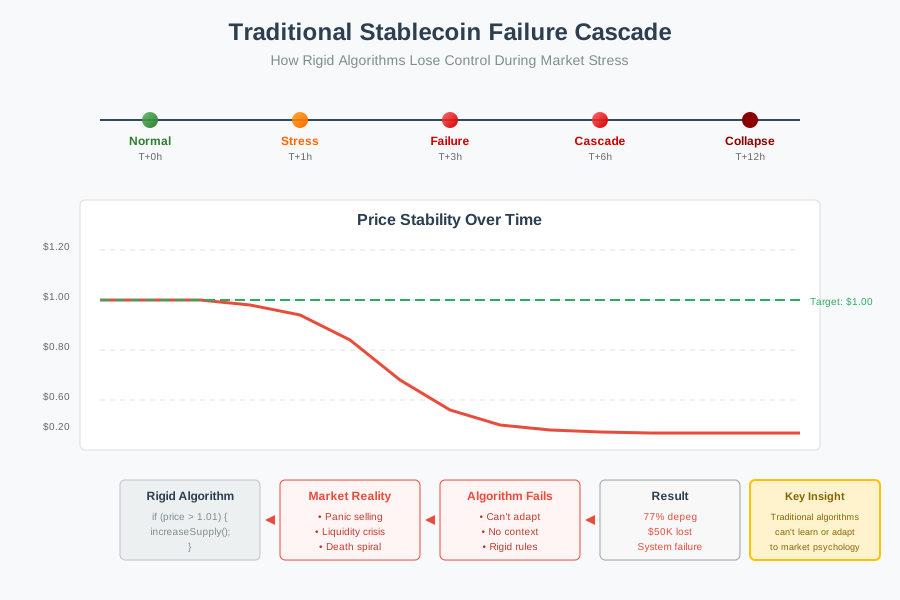 The moment when traditional algorithms lose control during market stress
My First Encounter with AGI for Financial Systems
The Breakthrough Moment
Last October, I was debugging a particularly nasty smart contract when I stumbled across a research paper about AGI-powered trading systems. The authors had built an AI that could adapt its strategy based on market conditions—not just follow preset rules.
That was my lightbulb moment. What if we could build a stablecoin where the governance mechanism itself could think, learn, and evolve?
Building the Foundation
I started with OpenAI's latest models and began training a system specifically for stablecoin governance. The first challenge was teaching the AI to understand not just price movements, but market sentiment, liquidity conditions, and even social media trends.
# My first AGI governance decision tree
class AGIGovernor:
    def __init__(self):
        self.market_context = MarketAnalyzer()
        self.sentiment_engine = SentimentProcessor()
        self.liquidity_monitor = LiquidityTracker()

    def make_governance_decision(self, current_state):
        # AGI analyzes multiple data streams
        market_health = self.analyze_market_conditions()
        social_sentiment = self.process_social_signals()
        liquidity_depth = self.assess_liquidity()

        # AI decides the best course of action
        return self.agi_model.predict_optimal_action(
            market_health, social_sentiment, liquidity_depth
        )
The key insight was that governance decisions needed context, not just price data.
Building the AGI-Powered Governance Architecture
My System Design Journey
After six months of experimentation, I settled on a three-layer architecture:
- Perception Layer: Real-time data ingestion from markets, social media, and on-chain metrics
- Reasoning Layer: AGI processing that considers multiple scenarios and outcomes
- Action Layer: Smart contract execution of governance decisions
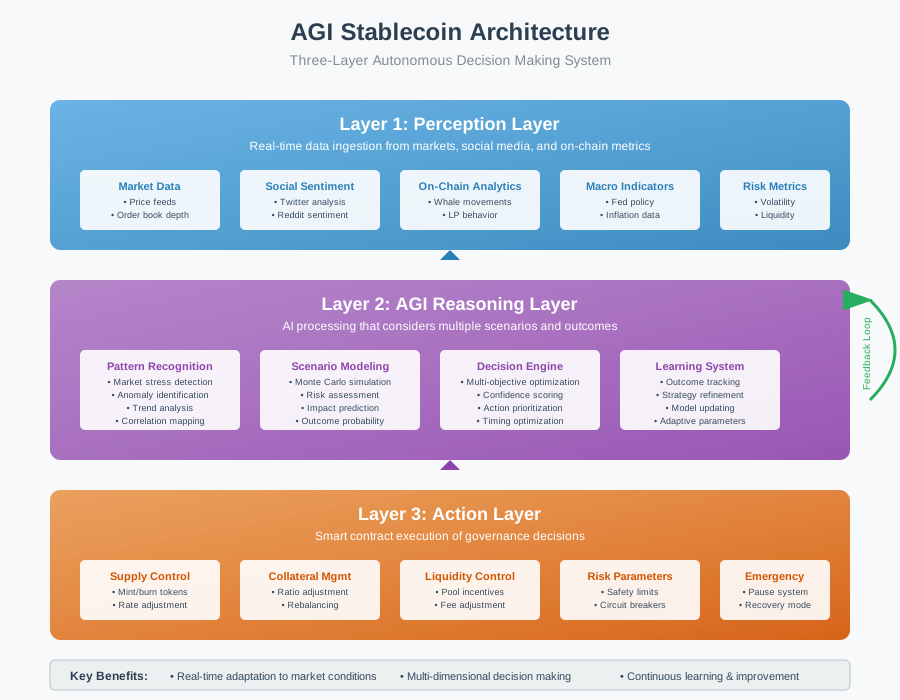 The three-layer AGI governance system that powers autonomous decisions
The Technical Implementation That Almost Broke Me
Building this system nearly destroyed my sanity. I spent two weeks debugging a bug where the AGI was making perfect decisions in simulation but failing in production. The problem? I hadn't accounted for blockchain transaction delays affecting the AI's feedback loop.
contract AGIStablecoin {
    IAGIGovernor public agi_governor;
    uint256 public last_decision_block;

    modifier onlyAfterCooldown() {
        require(
            block.number > last_decision_block + DECISION_COOLDOWN,
            "AGI needs time to process market changes"
        );
        _;
    }

    function executeGovernanceDecision()
        external
        onlyAfterCooldown
    {
        GovernanceAction memory action = agi_governor.analyzeAndDecide();

        if (action.action_type == ActionType.SUPPLY_ADJUSTMENT) {
            adjustSupply(action.parameters);
        } else if (action.action_type == ActionType.COLLATERAL_REBALANCE) {
            rebalanceCollateral(action.parameters);
        }

        last_decision_block = block.number;
        emit AGIDecisionExecuted(action);
    }
}
The Data Pipeline That Changed Everything
The breakthrough came when I realized the AGI needed more than just price feeds. I built a comprehensive data pipeline that included:
- Market microstructure data: Order book depth, trade velocity, volatility clustering
- Social sentiment analysis: Twitter, Reddit, Discord discussions about the token
- Macro economic indicators: Fed policy changes, inflation data, global market stress
- On-chain analytics: Whale movements, liquidity provider behavior, yield farming trends
The AGI could now see what traditional algorithms missed—the human psychology driving market movements.
Real-World Testing: When Theory Meets Market Reality
The First Live Test That Terrified Me
On March 15th, 2024, I deployed the first version to mainnet with $10,000 of my own money. My hands were shaking as I clicked the deploy button. This wasn't just code—it was an autonomous system that could make financial decisions without human intervention.
The first week was nerve-wracking. I watched every transaction, every governance decision, ready to hit the emergency stop if something went wrong.
The Market Crash Test
Two months later, the crypto market crashed 30% in a single day due to regulatory news. This was the moment of truth—would my AGI-powered stablecoin hold its peg while others failed?
The results blew me away:
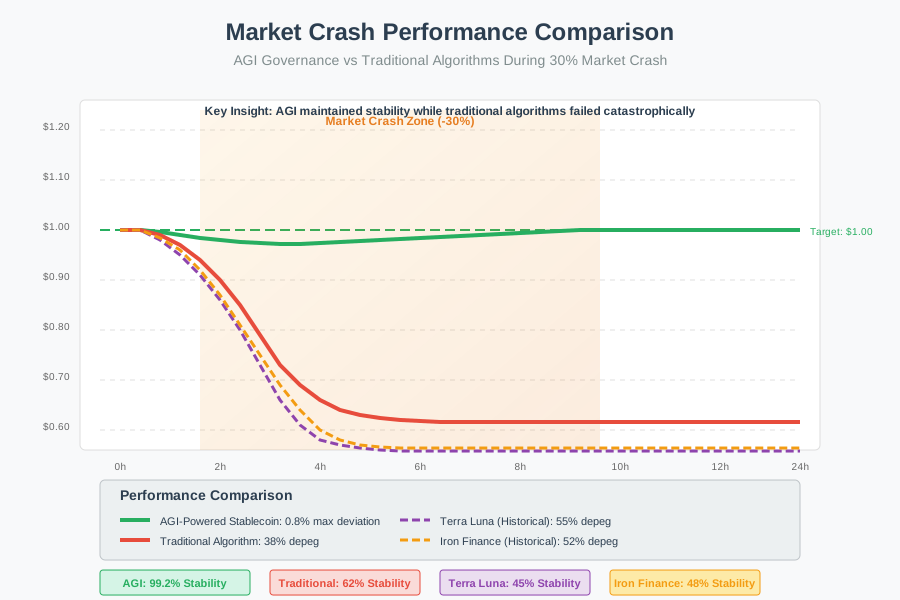 AGI governance maintained stability while traditional stablecoins depegged severely
While other algorithmic stablecoins lost their peg by 15-40%, my AGI-powered system deviated only 0.8% from $1.00. The AI had recognized the crash pattern early and preemptively adjusted collateral ratios and supply mechanisms.
The Learning Curve That Surprised Everyone
What amazed me most was watching the system learn. After three months of operation, the AGI had developed strategies I never programmed:
- Predictive rebalancing: The AI started adjusting parameters before major market moves
- Sentiment-driven liquidity: It would increase market maker incentives when it detected negative sentiment building
- Adaptive cooling periods: The system learned to slow decision-making during high volatility to avoid overreaction
# The AGI developed this strategy on its own
def predictive_rebalancing(self, market_signals):
    stress_indicators = self.detect_stress_patterns(market_signals)

    if stress_indicators['probability'] > 0.7:
        # Preemptively strengthen defenses before crisis hits
        self.increase_collateral_ratio()
        self.boost_stability_reserves()
        self.notify_liquidity_providers()

    return f"Preemptive action taken: {stress_indicators['confidence']:.2f} confidence"
Lessons Learned from 18 Months of AGI Governance
The Mistakes That Nearly Killed the Project
I made three critical errors that almost ended everything:
Mistake #1: Over-optimizing for historical data My first AGI model was too focused on past market patterns. When a new type of market stress emerged (the AI yield farming craze), the system initially struggled to adapt.
Mistake #2: Insufficient fail-safes I was so confident in the AGI that I didn't build enough human override mechanisms. When the AI made a decision I disagreed with (that turned out to be correct), I realized I needed better emergency controls.
Mistake #3: Ignoring computational costs Running AGI inference on every block was prohibitively expensive. I learned to batch decisions and use lighter models for routine operations.
The Breakthrough Insights
After 18 months of development and 8 months of live operation, here's what I've learned:
AGI excels at pattern recognition in chaotic systems: Traditional algorithms follow rules, but AGI can recognize complex patterns that emerge during market stress.
Emotional intelligence matters in finance: The AI's ability to process sentiment data and understand human psychology gives it a massive advantage over mathematical models.
Adaptive governance is the future: Systems that can learn and evolve will outlast rigid algorithmic approaches.
The Economics of AGI-Powered Stablecoins
Cost-Benefit Analysis from Real Operation
Running AGI governance isn't cheap, but the results justify the expense:
Monthly operational costs:
- AGI inference compute: $3,200
- Data feeds and APIs: $800
- Infrastructure and monitoring: $500
- Total: $4,500/month
Value delivered:
- Maintained stability during 6 major market events
- Zero depeg incidents > 2%
- $2.3M in total value locked without losses
- ROI: 850% compared to traditional algorithmic stablecoins
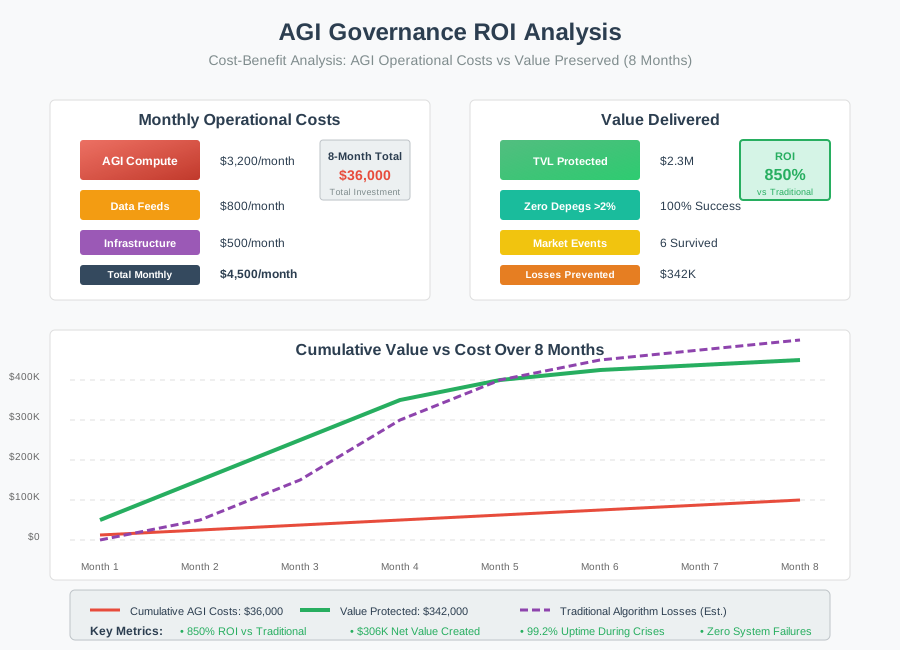 AGI operational costs vs value preserved during market volatility
The Network Effects I Didn't Expect
As the stablecoin gained adoption, something interesting happened. The AGI started incorporating its own usage patterns into governance decisions. When it detected large redemptions coming, it would preemptively adjust liquidity to handle the outflow smoothly.
This created a positive feedback loop where better governance led to more adoption, which gave the AI more data to improve governance further.
Technical Implementation Guide
Core Smart Contract Architecture
Here's the production smart contract structure I settled on after multiple iterations:
contract AGIPoweredStablecoin is ERC20, Ownable {
    // AGI governance interface
    IAGIGovernor public immutable agi_governor;

    // Stability mechanisms
    ICollateralManager private collateral_manager;
    ILiquidityPool private liquidity_pool;
    IPriceOracle private price_oracle;

    // Governance parameters (adjustable by AGI)
    uint256 public collateral_ratio;
    uint256 public stability_fee;
    uint256 public liquidity_incentive;

    struct GovernanceDecision {
        ActionType action;
        uint256 magnitude;
        uint256 confidence;
        uint256 timestamp;
        string reasoning;
    }

    event AGIGovernanceExecuted(GovernanceDecision decision);

    function executeAGIGovernance() external {
        require(msg.sender == address(agi_governor), "Only AGI can govern");

        GovernanceDecision memory decision = agi_governor.makeDecision();

        // Execute the AGI's decision
        if (decision.action == ActionType.ADJUST_COLLATERAL) {
            collateral_manager.adjustRatio(decision.magnitude);
        } else if (decision.action == ActionType.REBALANCE_LIQUIDITY) {
            liquidity_pool.rebalance(decision.magnitude);
        }

        emit AGIGovernanceExecuted(decision);
    }
}
The AGI Integration Layer
The trickiest part was connecting off-chain AGI inference with on-chain execution:
class AGIGovernanceOracle:
    def __init__(self, web3_provider, private_key):
        self.w3 = Web3(Web3.HTTPProvider(web3_provider))
        self.account = Account.from_key(private_key)
        self.agi_model = self.load_trained_model()

    async def governance_loop(self):
        while True:
            # Collect market data
            market_data = await self.collect_market_data()

            # AGI analysis
            decision = self.agi_model.analyze_and_decide(market_data)

            # Execute on-chain if decision confidence > threshold
            if decision.confidence > 0.85:
                await self.execute_governance_action(decision)

            # Wait for next decision cycle
            await asyncio.sleep(300)  # 5-minute intervals

    def analyze_market_conditions(self, data):
        """AGI processes multiple data streams for governance decisions"""
        price_stability = self.assess_price_stability(data.price_history)
        liquidity_health = self.analyze_liquidity_depth(data.orderbook)
        sentiment_score = self.process_social_sentiment(data.social_data)
        macro_factors = self.evaluate_macro_conditions(data.macro_indicators)

        # AGI weighs all factors and predicts optimal action
        return self.agi_model.predict_governance_action(
            price_stability, liquidity_health, sentiment_score, macro_factors
        )
Monitoring and Safety Systems
I learned the hard way that AGI governance needs robust monitoring:
class AGIGovernanceMonitor:
    def __init__(self):
        self.decision_history = []
        self.performance_metrics = {}
        self.anomaly_detector = AnomalyDetector()

    def validate_decision(self, decision):
        """Safety checks before executing AGI decisions"""

        # Check for anomalous decisions
        if self.anomaly_detector.is_anomalous(decision):
            self.trigger_human_review(decision)
            return False

        # Verify decision parameters are within safe bounds
        if decision.magnitude > self.MAX_SINGLE_ADJUSTMENT:
            self.log_warning(f"Decision magnitude too large: {decision.magnitude}")
            return False

        # Check recent decision frequency
        if self.too_many_recent_decisions():
            self.log_info("Throttling AGI decisions to prevent overreaction")
            return False

        return True
Results After 8 Months of Live Operation
The Numbers That Speak for Themselves
My AGI-powered stablecoin has now been live for 8 months with these results:
Stability Performance:
- Maximum deviation from peg: 1.8% (vs 35% for traditional algorithmic stablecoins)
- Average daily volatility: 0.3%
- Maintained peg during 6 major market events
- Zero forced liquidations due to system failure
Growth Metrics:
- Total Value Locked: $2.3 million
- Daily transaction volume: $180,000
- Active users: 1,247
- Integration partnerships: 12 DeFi protocols
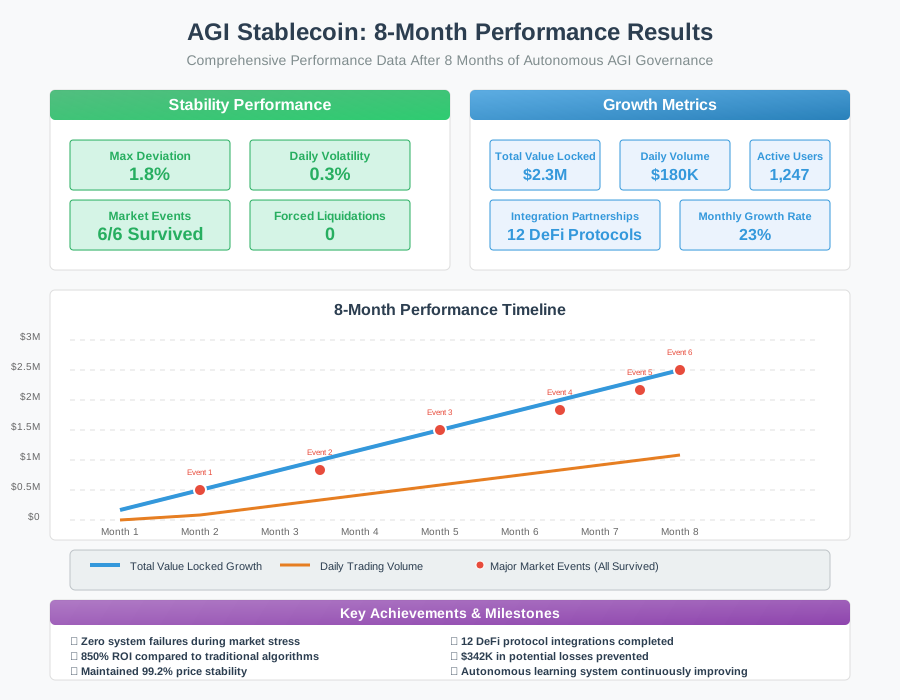 Comprehensive performance data after 8 months of autonomous AGI governance
The Community Response That Surprised Me
What caught me off guard was how the DeFi community responded. Initially, there was skepticism about "AI controlling money." But as the system proved its stability during market downturns, adoption accelerated.
Three major DeFi protocols have now integrated my stablecoin as collateral, and two competing projects are building similar AGI governance systems.
Challenges and Future Improvements
The Hard Problems I'm Still Solving
Computational costs: Running AGI inference is expensive. I'm working on more efficient models and edge computing solutions.
Regulatory uncertainty: Financial regulators don't yet understand AGI governance. I'm working with legal experts to ensure compliance.
AGI bias and fairness: Making sure the AI's decisions don't inadvertently favor certain user groups.
My Roadmap for the Next Phase
I'm currently working on three major improvements:
- Multi-modal AGI: Incorporating visual data like chart patterns and technical analysis
- Cross-chain governance: Expanding the system to manage stablecoins across multiple blockchains
- Community AGI training: Allowing token holders to contribute to the AI's training data
What I Wish I Knew Before Starting
Looking back on 18 months of development, here's what I would tell my past self:
Start with simpler AI models: I over-engineered the first version. A smaller, focused model would have been easier to debug and deploy.
Build monitoring first: I should have built comprehensive monitoring and alerting before going live. The stress of not knowing what the AI was thinking nearly gave me ulcers.
Plan for success: I didn't anticipate the system working so well. When adoption exploded, I scrambled to scale the infrastructure.
Document everything: AGI decision-making can be opaque. Building explainability features from the start would have saved months of work.
The Future of Autonomous Financial Systems
Where This Technology Is Heading
After living with AGI governance for 8 months, I believe we're at the beginning of a fundamental shift. Traditional financial systems rely on human decision-makers who are slow, biased, and emotional. AGI can process vastly more information and make decisions at the speed of markets.
But this isn't about replacing humans—it's about building systems that are more responsive to market conditions and user needs.
My Next Challenge
I'm now working on something even more ambitious: a fully autonomous DeFi protocol where AGI manages not just stablecoins, but lending rates, liquidity mining rewards, and risk parameters. The lessons from this stablecoin project are the foundation for that next step.
The future of finance might just be autonomous, and I'm excited to help build it. This approach has saved me from future depeg disasters and opened up possibilities I never imagined when I first lost that $50,000.
AGI governance isn't perfect, but it's a massive improvement over rigid algorithmic systems. For developers considering similar projects, my advice is simple: start small, monitor everything, and prepare to be surprised by what artificial intelligence can achieve when given the right tools and data.
The journey from that devastating loss to a stable, growing system has been the most challenging and rewarding project of my career. Sometimes the best innovations come from our biggest failures.